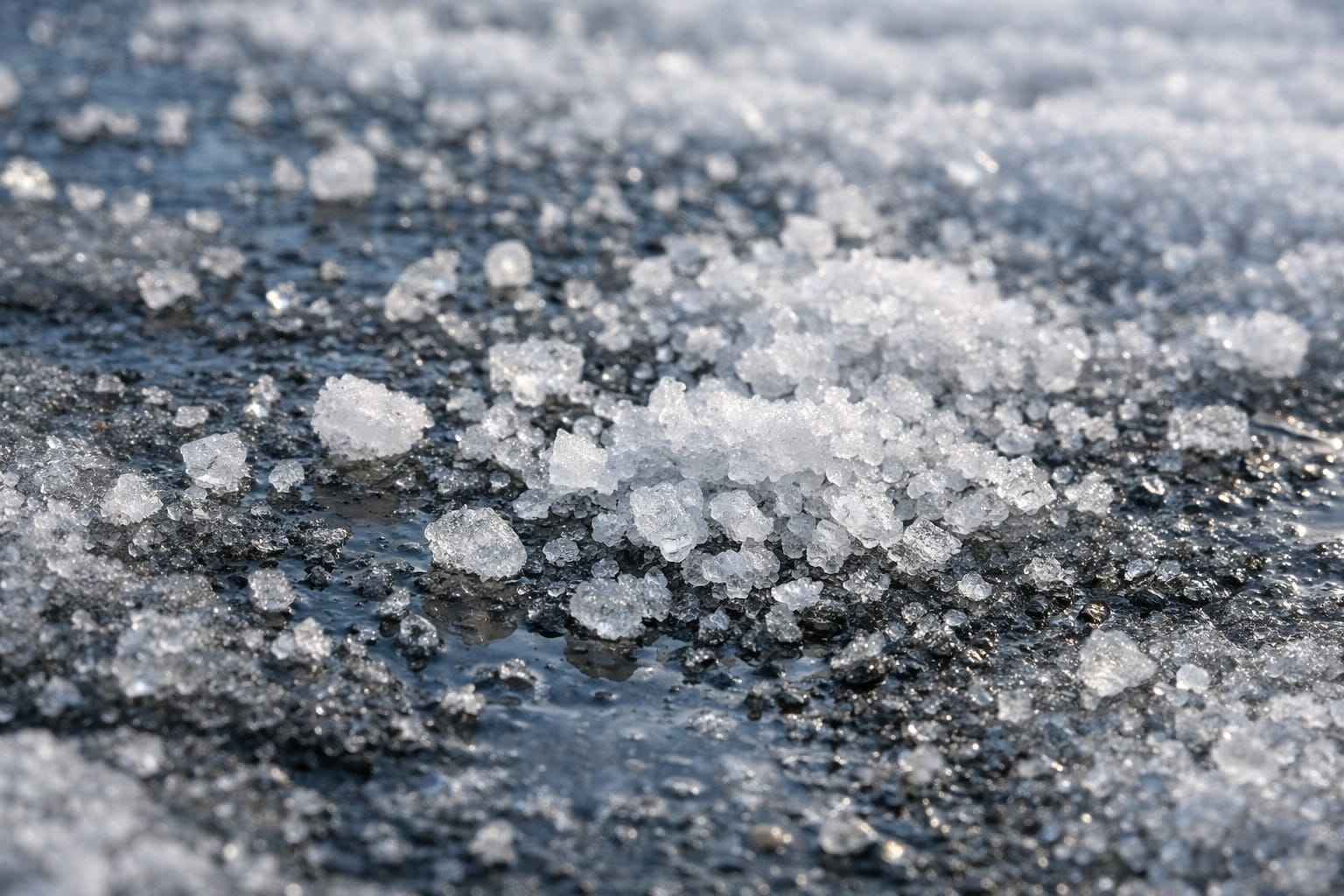
Will Pool Salt Melt Ice? Practical Answers for Industrial Buyers
Will pool salt melt ice?
Yes. Pool salt can melt ice, because it is typically composed of sodium chloride (NaCl), the same chemical compound used in many traditional de-icing salts. When sodium chloride dissolves in water, it lowers the freezing point of water, a phenomenon known as freezing point depression. This process causes ice to melt even when temperatures are below 0 °C (32 °F).
In practice, pool salt works in a similar way to common rock salt used for de-icing. Once spread on ice or snow, it dissolves into the thin liquid layer that naturally forms on ice surfaces, lowering the freezing point and accelerating melting.
Does pool salt melt ice effectively?
Yes, but with limitations.
Pool salt melts ice effectively in moderate winter temperatures, especially above approximately −9 °C to −10 °C (15 °F). Below this temperature range, sodium chloride becomes significantly less effective.
This is because sodium chloride solutions stop lowering the freezing point effectively at lower temperatures, meaning the melting process slows or stops.
For this reason:
- Sodium chloride is commonly used for roads, sidewalks, and driveways
- In very cold climates, other de-icing agents such as calcium chloride or magnesium chloride may perform better
Can pool salt be used to melt ice on a driveway?
Yes. Pool salt can be used to melt ice on driveways, walkways, and paved surfaces, especially when the product is available in bulk and the temperature is within the effective melting range of sodium chloride.
However, there are a few considerations:
- Pool salt crystals are often larger and purer than standard de-icing salt
- They may dissolve more slowly, depending on granule size
- In many cases, they perform similarly to rock salt for ice melt
For industrial buyers or distributors handling large quantities of salt, this makes pool salt a functional alternative for certain de-icing applications.
Is pool salt the same as ice melt?
Not exactly.
While pool salt and many ice-melt products share sodium chloride as a base, ice-melt formulations often include additional chemicals designed to improve performance at lower temperatures.
Common differences include:
Pool salt
- Usually high-purity sodium chloride
- Designed for water treatment in pools
- Typically larger crystals
Commercial ice melt
- May contain sodium chloride, calcium chloride, magnesium chloride, or blends
- Designed for faster melting and colder temperatures
- Often formulated for specific winter conditions
Because of these differences, ice-melt products can perform better in extreme cold.
Will pool salt melt snow as well as ice?
Yes, pool salt can melt both snow and ice, but it works most effectively after snow has been compacted or partially melted.
In fresh snowfall:
- Mechanical removal (shoveling or plowing) should come first.
- Salt is then applied to prevent refreezing and break down residual ice layers.
This approach improves efficiency and reduces the total amount of salt required.
Does pool salt work for ice melt in large-scale applications?
In bulk supply contexts, sodium chloride products—including pool salt—can be used for winter maintenance, depending on operational requirements.
Typical applications include:
- Industrial sites and logistics hubs
- Parking areas and access roads
- Distribution centers
- Municipal winter maintenance programs
Large-volume users often evaluate:
- Granule size
- Purity
- Dissolution speed
- Temperature performance
These factors influence whether pool-grade sodium chloride or dedicated de-icing salt is the most efficient solution.
Reference:
Reference:
- https://www.britannica.com/science/freezing-point-depression
- https://www.usgs.gov/special-topics/water-science-school/science/road-salt-and-water-quality
- https://www.fs.usda.gov/t-d/pubs/htmlpubs/htm06772201/page11.htm
- https://www.epa.gov/safewater/winter-weather-and-road-salt
- https://www.extension.purdue.edu/extmedia/ID/ID-412-W.pdf
- https://www.fhwa.dot.gov/environment/winter_road_salt/
- https://www.usda.gov/media/blog/2019/01/29/how-road-salt-works